Ghent’s first circular footpath
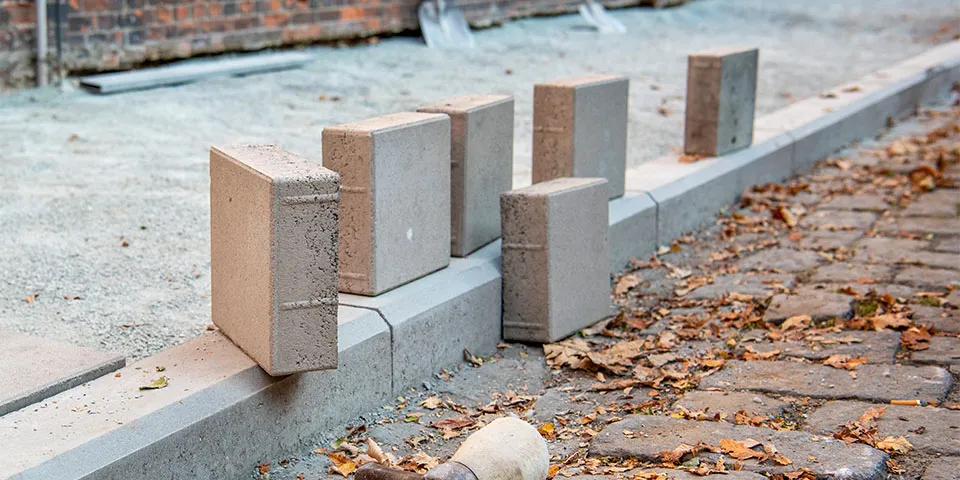
Ghent is the first city in Belgium to get a circular footpath. The 110 m2 section is outside Arteveldehogeschool in Leeuwstraat.
The footpath has been laid using Carbstone pavers, made with Carbstone technology developed by VITO and Orbix. This technology makes it possible to produce building materials by reacting two waste products: metal slags, a by-product of steel production, and CO2.
Words | Stad Gent / Niels Rouvrois Images | Stad Gent
What makes these pavers circular? They use waste from residual streams, which is itself turned back into raw material. In addition, no conventional cement or concrete products are used in their production. As a result, the pavers absorb more CO2 during production than is released. This significantly reduces their environmental impact. And it does not stop at pavers. The new technology can be used to produce a wide range of products with the same technical properties as conventional concrete products.
A stepping stone towards a circular city
The footpath is the result of the ‘Stepping stone towards a circular city’ project, in which partners VITO, Orbix, UGent, Vlaanderen Circulair and Stad Gent investigated the use of sustainable materials in the urban environment, with a view to using them as building materials. The project provided insights into the technical aspects of development, as well as potential barriers and opportunities for introducing sustainable technology.
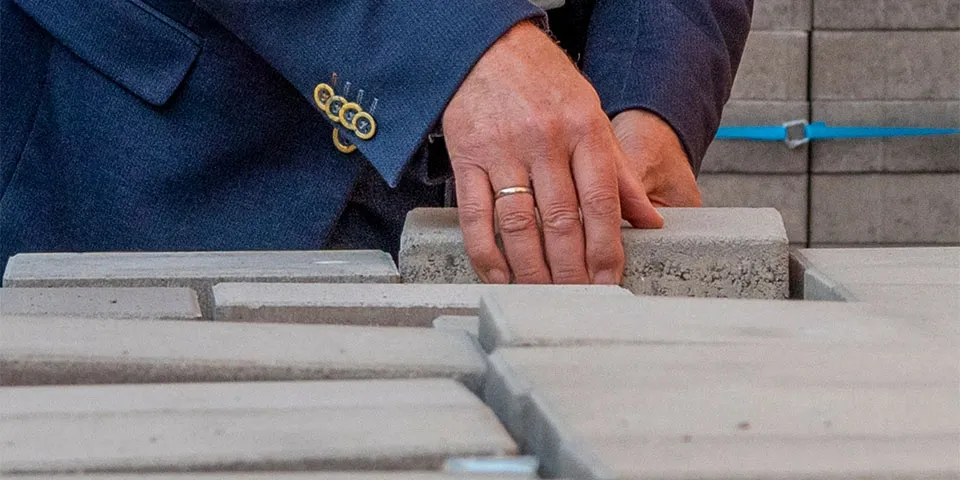
The footpath has been laid using Carbstone pavers, made with Carbstone technology.
The public report provides a detailed account of the Carbstone process, the properties of Carbstone pavers and lessons learned from the project. The process consists of three stages: preparing the mix, shaping and carbonation. The aim was to use as much local raw material as possible. In Ghent, this was sourced from Arcelor Mittal, which supplied LD slag from steel production. This was supplemented with mineral fractions recovered by Orbix from stainless steel slag supplied by Aperam in Genk. The pavers were shaped using a Metalika vibratory press at Orbix’s pilot plant in Farciennes. Finally, the pavers are carbonated in a drying chamber, or in this case an autoclave, where CO2 is fed to them for around 20 hours.
Market availability
This is the first time Orbix has produced 110 m² of pavers using Carbstone technology for a demonstration. The pavers are not currently available to buy, except for demonstrations or pilot projects. They are produced at the pilot plant in Farciennes. However, Carbstone facing bricks produced at a partner’s pilot plant in Lanklaar will come onto the market next year. Several companies in Belgium and abroad are also interested in producing Carbstone pavers and building blocks. These partners will be responsible for production and sales themselves, and will announce availability in due course.
Circular economy
Stad Gent has long been committed to a circular economy in which raw materials are not lost, but kept in circulation. Together with the partners of the Cleantech Cluster Regio Gent, established in 2016, the city council is pursuing a programme of actions and projects to develop a circular economy. Reusing building materials in the city is an important part of this. “Stad Gent wants to show that collaboration between different partners pays off, that materials based on reuse or new compositions are reliable, and that they can enable new business models. In short, we want to fully embrace our role as a test bed, including by using circular materials in buildings and infrastructure within our territory,” says Alderman for the Economy Sofie Bracke.
Question about this story? Ask your question
Keep following this
Get an email when a new story is published. No account needed.
- SubjectRoad construction