Versatile robot assists land surveyors
Surveyors who regularly work on large sites such as motorways know all too well that setting out points over distances of several kilometres is no fun, even with a good GPS surveying system. Whether measuring or locating, the repetitive nature of these long-distance tasks makes them very tiring and, in the worst case, can even cause back pain. Fortunately, a solution has recently become available: a small wheeled robot.
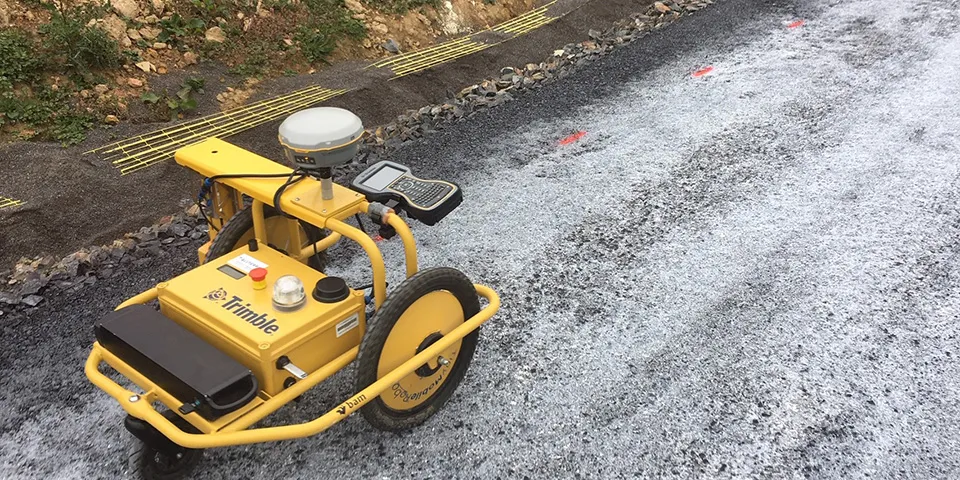
Since last year, the robot has featured in the product catalogue of AllTerra. The TinySurveyor is specially designed to make pre-marking and setting out more efficient. Simply load the coordinates onto the robot using a USB stick to set it to work. It can handle all types of terrain and uses a Trimble GPS system to guide it to within centimetres, tracing control points or lines at regular intervals. The robot can also be operated using a total station in places where the GPS signal may drop out, such as tunnels.
Fast
The TinySurveyor’s main advantage is its speed, up to 7 km/h. According to the manufacturer, it can reduce the workload by 75%. This is confirmed by Gaetan Calberson, a surveyor at BAM Contractors, who is currently working on the Couvin ring road project. “It saves me a huge amount of time when setting out. Yesterday, for example, I covered 4 kilometres of road in half a day. Without the robot, it would have taken a full day, with two surveyors, of course. Before the robot arrived, I did everything manually with a survey pole, setting out points every 10 metres. Now that the robot effectively sets out points every metre, the workers no longer need to run a string line, as 10 metres was a bit too long for their machine. That saves us two people on site.”
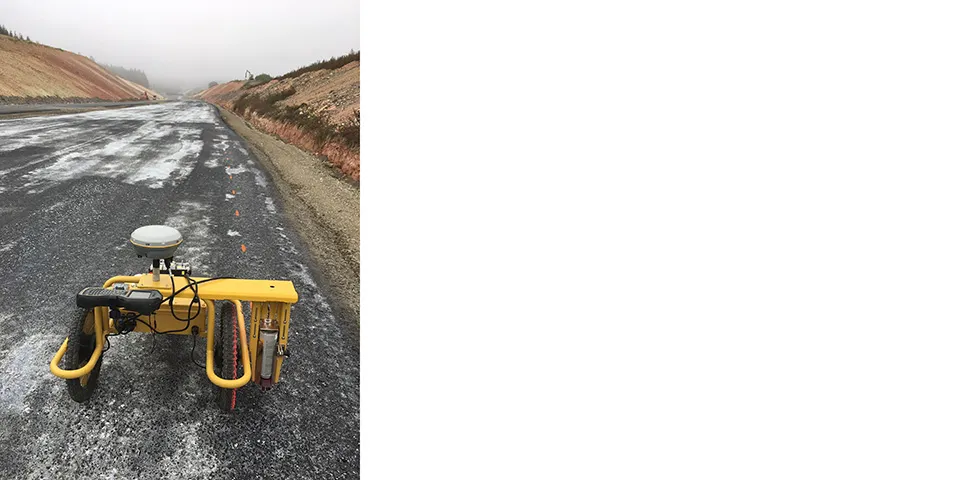
The robot uses a Trimble GPS system to guide it to within centimetres, tracing control points or lines at regular intervals.
Versatile
Gaetan Calberson uses the TinySurveyor to mark the edges of the sandwich layer on the lean concrete. Phase 2 of the Couvin ring road project is currently under way, covering 9 kilometres between Ry de Rome and the Belgian-French border. It is due for completion in summer 2019. “I upload the project file, then the robot determines a point on the intended line and sets off to mark it out. We can configure it however we like: set control points every 1, 2 or 3 metres, or mark out lines every 10 or 20 centimetres …
For the asphalt-laying crews, I mark out 10-centimetre lines every metre. They use their machine to follow the line while laying the asphalt to the required thickness.” The robot is then used again to lay the continuous reinforced concrete edges on the sandwich layer.
Next, a company specialising in road markings gets to show what it can do. It too seems to have plenty of use for the robot. Michael Werny of Établissements Lambert Marquage says: “The robot assists us in laying the final road markings.” In other words, it is used to set out the preliminary markings that guide the machine applying the road markings. “With the traditional method, three people pull strings and set out points by following them. When you use the robot, you only need one person to supervise the whole operation.” Lambert Marquage has also carried out other major projects using the TinySurveyor, including at Bierset Airport and on the A27 motorway, over a distance of 24 kilometres.
Another possible application is setting out points for pile foundations. Francis Demeurechy, TinySurveyor expert at AllTerra, says: “The TinySurveyor has been used at the port of Tanger, where a total of 70,000 points were set out. The robot is useful anywhere a labour-intensive process can be automated. Almost anything is possible.”
A business enquiry for AllTerra Belux? Get in touch
Companies in this story
Keep following this
Get an email when a new story is published. No account needed.
- SubjectMachines & equipment
- CompanyAllTerra Belux