The advantages of precast concrete signage and markings
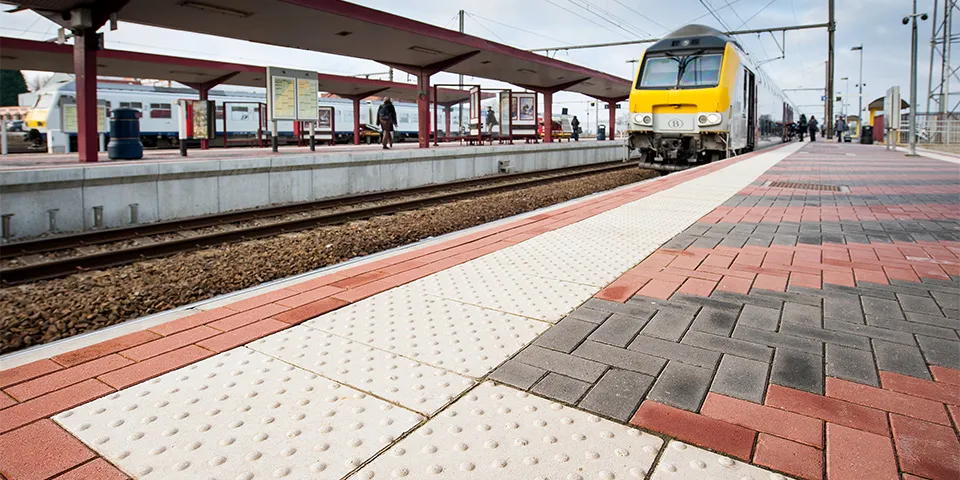
With safety as a guiding principle, road markings and signage on roads and in public spaces play an important role in our daily lives. FEBESTRAL, the trade association within FEBE representing manufacturers of precast concrete products for the paving market, highlights the qualities of precast concrete for road signage and markings. “The possibilities are extensive,” says Sven Tilkin, product development manager at STRADUS, a manufacturer of precast concrete paving and bespoke products and a member of FEBESTRAL.
FEBE is the recognised trade association for manufacturers of precast concrete products and represents the interests of the sector. The Belgian concrete industry produces a wide range of precast elements for construction, from simple, unreinforced products such as masonry blocks and paving stones to large structural elements such as bridge beams. FEBESTRAL operates within FEBE as a sub-association bringing together manufacturers of precast concrete products for the paving market, including concrete paving blocks, concrete flags, linear elements and accessories. FEBESTRAL supports the marketing of its members’ products, both technically and promotionally. Road user safety and comfort are among the top priorities for FEBESTRAL’s manufacturers.
White concrete is now incorporated to create a 2 cm thick white line that will never disappear.
A broad range
Guidance lines with a ribbed surface, warning markings with a staggered stud pattern, concrete markings with a black rubber layer, letter and symbol paving slabs for public spaces, zebra crossings made with reflective blocks, refuge islands, speed humps and speed cushions… There are many ways to use precast concrete products for road markings and signage. Sven Tilkin says: “Concrete in general, and precast concrete in particular, has many qualities and advantages. The main advantage of precast concrete is that production always takes place in optimal conditions, without depending on external factors such as the weather. Precast concrete also offers considerable freedom of form, making the range of possibilities very broad. This is particularly useful for signage and markings. Design freedom means we can offer a very wide range of signage.”
Precast concrete has also proven its durability over time. “This is certainly true of precast concrete products used for signage and markings,” Sven Tilkin emphasises. “Speed humps are a good example. We were already making them fifteen years ago, but the markings were then applied using thermoplastic material. That was not a problem in itself, but traffic loads meant the markings were not very durable and could wear quickly. In time, you were left with a speed hump but no effective signage. Today, white concrete is incorporated to create a 2 cm thick white line that will never disappear. Reflective blocks are also becoming increasingly popular. The next step is to incorporate reflective markings into larger precast elements such as speed humps or New Jersey barriers. So not just white concrete, but white concrete with reflective properties to improve visibility and make the signage more effective.”
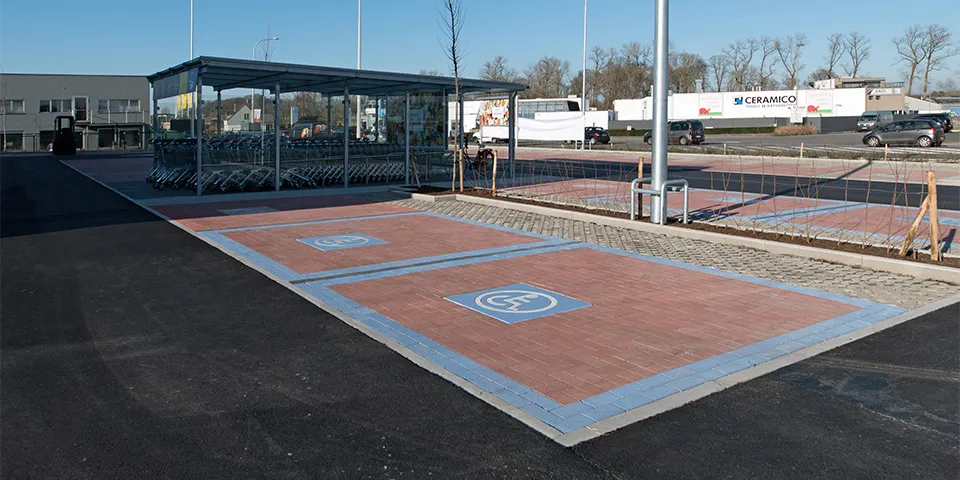
Precast concrete offers considerable freedom of form, making the range of possibilities very broad.
Suitable formats and laying patterns
The many possible combinations of precast concrete paving products make it possible to clearly delineate each street or public space, improving safety. Choosing a suitable format and laying pattern for each zone also ensures optimum comfort and effective signage. “You can experiment with formats, colours and textures. This allows you to guide people through public spaces, either with contrasting designs or more subtly. A rough surface, for example, reduces speed. But it also creates more noise, so it is not desirable near homes. A lot has changed in terms of colour in recent years. Twenty years ago, the choices were grey, black and red. Now we can produce a huge range of colours, and the colour palette keeps expanding. But when it comes to safety, white will remain the main colour because it reflects light best,” concludes Sven Tilkin.
Een zakelijke vraag aan STRADUS? Get in touch
Companies in this story
Keep following this
Get an email when a new story is published. No account needed.
- ThemeSpace for water and green infrastructure
- SubjectMachines & equipment
- CompanySTRADUS