Beltrami introduces Fossil Stone
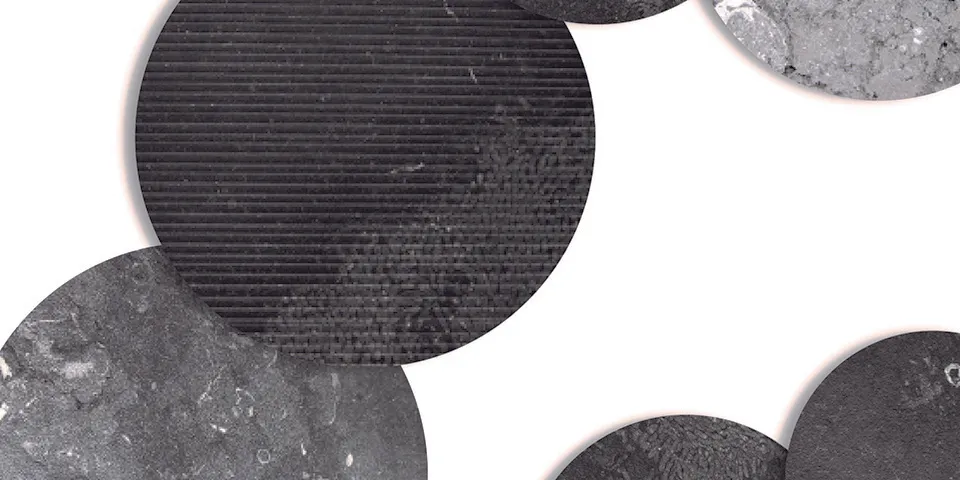
This year, Beltrami Natural Stone is showcasing a remarkable and highly exclusive product from the fossil layer of the Kilkenny Limestone quarries at Architect@Work. These Irish Blue Limestone quarries are owned by the Brachot-Hermant Group, which also includes Beltrami Natural Stone.
Beltrami has been part of the Belgian Brachot-Hermant Group since 2017, a global player in the natural stone market. The group manages the entire chain, from quarry to finished product: extraction from its own natural stone quarries, production, including cutting blocks into slabs and tiles and finishing their surfaces, and finally the distribution of natural stone slabs and tiles to the trade.
Beltrami itself has been an innovator and creative trendsetter in natural stone for more than thirty years. As a result, the company has built up a very broad range of expertise, while continuing to seek out new materials, sizes, colours, finishes and applications. Direct supplies from the Brachot-Hermant Group’s quarries give Beltrami even more opportunities to introduce distinctive products and respond quickly to the latest home-design trends.
Customers clearly appreciate Beltrami’s exclusive range. Natural stone remains an exceptionally versatile and durable natural material for high-quality interior and exterior finishes that become even more beautiful over time.
Fossil Stone from Kilkenny Limestone is unique for the presence and abundance of oyster and coral fossils. The material is extracted exclusively from the Irish quarries at Carlow and Kellymount. For Fossil Stone, natural stone blocks are carefully selected from the rare layer in the quarries that contains an exceptional number of fossils.
The fossil traces date back hundreds of millions of years. As well as extracting and selecting the right natural stone blocks, the slabs are cut and worked with the utmost precision and expertise, ensuring that only the finest examples are offered in the unique Fossil category.
Finishing is carried out, among other places, at the Beltrami Stonelab in Harelbeke. Surface treatment gives Kilkenny Limestone a different appearance: lighter or darker, rough, smooth or more matt, with or without a tactile texture, and so on.
Fossil
Within Fossil Stone, we distinguish between the Fossil and Coral ranges. Fossil features large white oyster and shell fossils set in the limestone. Especially for Architect@Work, this natural stone will be presented with the innovative Letano surface finish. This treatment gives the stone slab a very matt, dark appearance, making the white shell fossils stand out beautifully against it.
The Fossil range is suitable for exclusive indoor applications, including tiles and interior finishes, and outdoor applications, including cladding and paving. It is available both as standard tiles measuring 60/40 cm or 60/60 cm with a Sensato finish, and as slabs in a variety of finishes. The slabs are ideal for interior finishes, for example as worktops or stair treads, and can also be cut into tiles to suit the required size.
Coral
The Coral range is distinctive for its large coral patterns on the surface. A series of finishes will be creatively showcased at Architect@Work. The Coral variety of Irish Fossil Stone is used for indoor applications, including wall and floor cladding, and is also suitable for outdoor paving and cladding.
Bstories!
Fossil Stone flooring at Scottish design museum V&A Dundee
The Victoria & Albert Museum in Dundee, the first design museum in Scotland, opened its doors in the summer of 2018. The impressive museum building, with a budget of more than 80 million British pounds, is an architectural feat designed by Japanese architect Kengo Kuma. The architect chose Fossil Stone with a Letano finish for the flooring. A distinctive feature of the installation is its random-length pattern, with lengths ranging from 80 cm to 100 cm and a width of 30 cm. No fewer than 400 Fossil Stone treads were used to finish the stairs. In total, Kilkenny Limestone supplied around 30 m3 of natural stone for this substantial project.
The striking building has an area of 8,000 m2, including 1,650 m2 of exhibition space, and is beautifully positioned on the banks of the Scottish River Tay. Its exterior walls comprise numerous horizontal panels that create an elegant play of lines. This makes the building’s form resemble a boat, while the structure also echoes the nearby Scottish cliffs.
Redevelopment of Brussels’ central avenues with Irish Blue Limestone
In Brussels, De Brouckèreplein, Fontainaplein, Anspachlaan, the surrounding streets and the pedestrian zone are all undergoing a complete, sustainable makeover. Work is well under way and is scheduled to continue until the end of 2019. Kilkenny Limestone is supplying 12,000 tonnes of Irish Blue Limestone, covering a total area of 36,442 m2 in four different finishes: split, bush-hammered, sawn and flamed. The supply includes tiles, kerbs and tactile paving tiles with raised studs or bars. Dimensions vary, with thicknesses of
8 and 12 cm and sizes of 20×5/30×5/30×8/40×8 cm.
Question about this story? Ask your question
Keep following this
Get an email when a new story is published. No account needed.
- SubjectMachines & equipment